


Red dot selection guide
Red dot sights and their mounts
Over the years, specific standards have developed for attaching red dot sights. In the past, it was common for red dot sights to be attached to guns with the same ring-shaped scope feet as the scopes. Although such red dot sights are still available, nowadays red dot sights have become smaller and the most commonly sold models use other mounting solutions.
Aimpoint Micro series sights have been so popular that tripods are available for them from numerous accessory manufacturers and several other sight manufacturers have also started using the same mounting solutions. For example, Holosu's 403/503/530 scopes use Aimpoint Micro compatible tripods.
Docter Sight was once the pioneer in small open-top red dot sights. Several other scope manufacturers, such as Burris, Meopta and Vortex, use the same tripod solutions with it. Other tripod models that have already become somewhat of a standard are Trijico's RMR tripods and Shield SMS/RMS tripods. For example, Holosun's scopes HS407C, HS507C and HE508T use Trijicon RMR-type tripods, and Holosun's smaller models HS407K and HS507K use Shield SMS/RMS tripods.
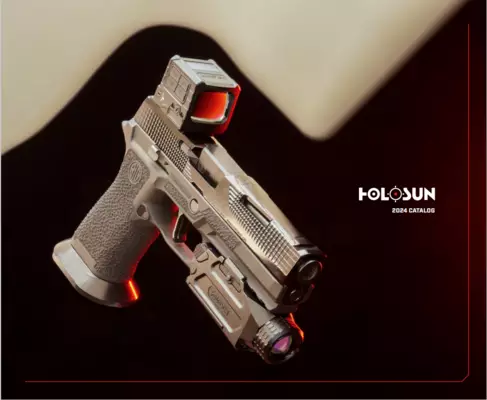
Small red dot sights are often used in pistols these days, and "Optics Ready" pistol models have appeared from various gun manufacturers, which have a ready place for attaching a red dot sight to the slide of the gun. In some station models, the sight is attached directly to the slide, and in some, a separate base plate is needed between the slide and the sight. Accessory stands are also available. Red dot sights can also be attached to many pistols instead of the original iron rear sight. Available are the so-called multibase tripods with mounts for several different red dot sight models.
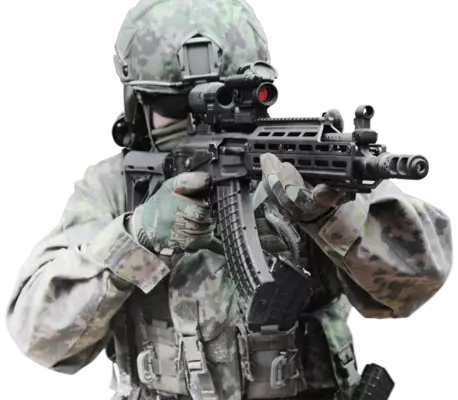
Red dot sights are also widely used in long guns. In them, they are used both as an actual sight and as an auxiliary sight with e.g. a binocular sight. In the auxiliary sight role, the red dot sight can be attached to the weapon, e.g. at a 45° angle to the side of the weapon, in which case the auxiliary sight can be used by tilting the weapon to the side. There are also red dot stands that attach to the scope. When using a red dot sight as the main sight of the gun, tripods of different heights may be needed. Some Holosun models (e.g. HS403/503) include two tripods of different heights that fit Picatinny and Weaver rails. A lower base is good for most hunting weapons and, for example, AK-type reserve rifles. The taller stand is well suited for use on an AR-15 rifle (1/3 Co-witness).
In the AR-15 rifle, the red dot sight is also suitable for use with iron sights. Many people want iron sights as spare sights for their guns in case the optics break down or the battery runs out. The red dot sight can be installed between the iron sights, so-called To the Co-witness height, when looking through the iron sights, the red dot is visible at the end of the front grain. Absolute Co-witness means that the sights are in the middle of the center line of the red dot sight. In the 1/3 Co-witness installation height, the center line of the red dot sight is higher than the center line of the iron sights, so that the iron sights are visible in the lowest third of the red dot sight's field of view. In this case, the iron sights are still available together with the red dot sight, but they cover less of the field of view. This is especially useful when using iron sights, which cannot be folded down when not needed.
In general, dimensions in millimeters and inches:
Absolute co-witness: 35.56mm or 1.4''
1.5 inch height: 38.1mm or 1.5''
Lower 1/3 co-witness: 40.64mm or 1.6''
NOTE! Some manufacturers use slightly different measurements for different verbal heights. E.g. On another, a low 1/3 co-witness can throw a few e.g. compared to another manufacturer. That this wouldn't be too easy either!
In some situations, there may be a need for even higher red dot sight stands. For example, installing a laser sight on a rifle may cause the need to raise the red dot sight higher. Also, the use of some equipment, such as a helmet with a visor, may require the use of a higher aiming stand on the weapon. Today, several manufacturers already make 1.93"/49mm high Aimpoint Micro-compatible tripods for this purpose. Such a high stand does not allow co-witness mounting with standard height AR15 iron sights.
Red dot vs. Holographic dot differences
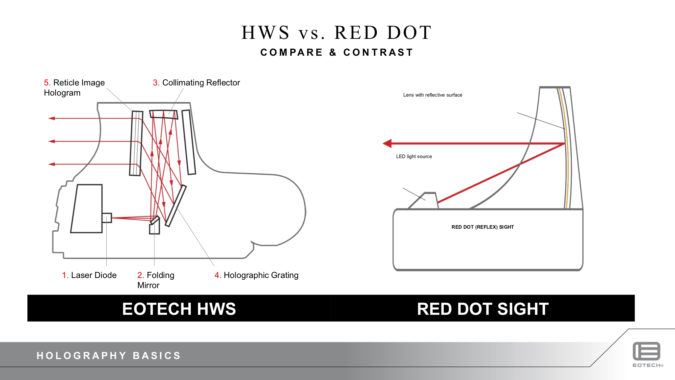
Image: Holo vs red dot, Eotech.
A holographic sight has a lot of mirrors compared to a red dot, so the end result is usually expensive and complicated, while a red dot is simpler and usually more affordable.
In a holographic sight, at least in theory, the eye sees the aiming point on the target, while in a red dot sight, the eye sees a red dot between the target and the eye. Only the target or dot can be clearly seen in the red dot. In practice, however, the difference is not big, but, for example, when handling the magnifier, you notice that the dot remains small in the holoscope, even if you look at it through the magnifier, i.e. the target grows and the dot does not. In the red dot sight, on the other hand, the dot and the target increase by the magnification.
There is a difference, but these are usually matters of opinion and preference.